


▎What Is ASTM F714 HDPE Pipe?
For a buyer entering the polyethylene piping industry for the first time, specifications such as ASTM F714, ASTM D3035, ASTM D3350, AWWA C906, PE4710, IPS, DIPS, DR11 and DR17 can quickly become confusing.
The easiest way to understand ASTM F714 is this:
ASTM F714 is one of the principal ASTM dimensional and performance specifications used for larger-diameter polyethylene (PE) pipe based on controlled outside diameter and Dimension Ratio (DR).
Its full title is:
ASTM F714 – Standard Specification for Polyethylene (PE) Plastic Pipe (DR-PR) Based on Outside Diameter.
ASTM F714 covers polyethylene pipes manufactured in three major outside-diameter sizing systems:
IPS – Iron Pipe Size
DIPS – Ductile Iron Pipe Size
Metric sizing
Under the current specification, the scope begins at DIPS 3, IPS 4 and Metric 90 mm, while smaller sizes are generally addressed through ASTM D3035.
The standard is relevant to PE pipelines used for applications such as:
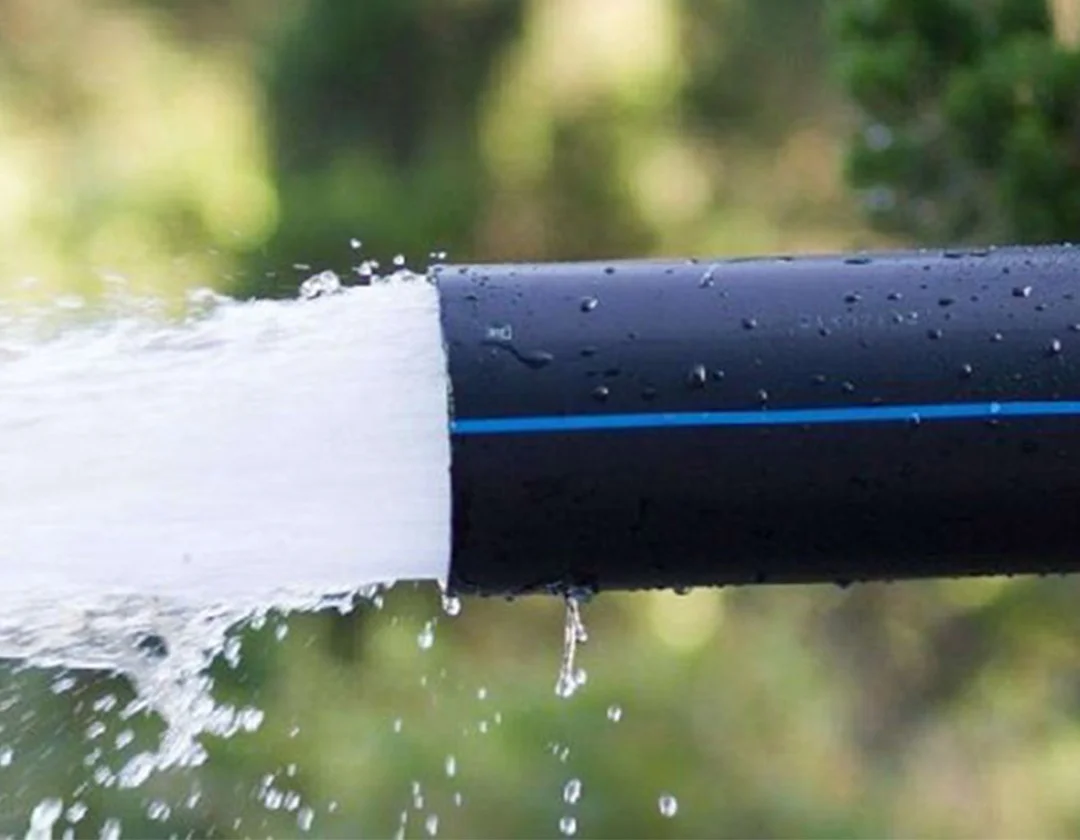
Potable water transmission
Municipal water distribution
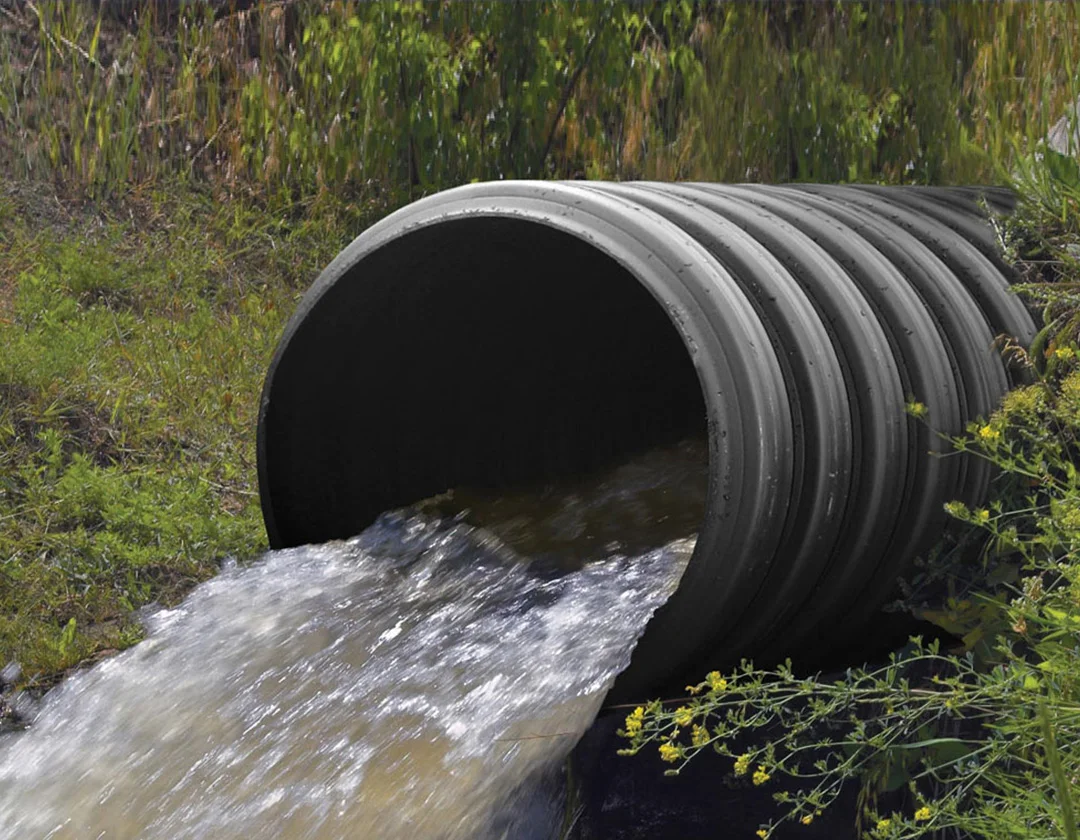
Municipal sewer systems
Industrial process water
Wastewater and effluent
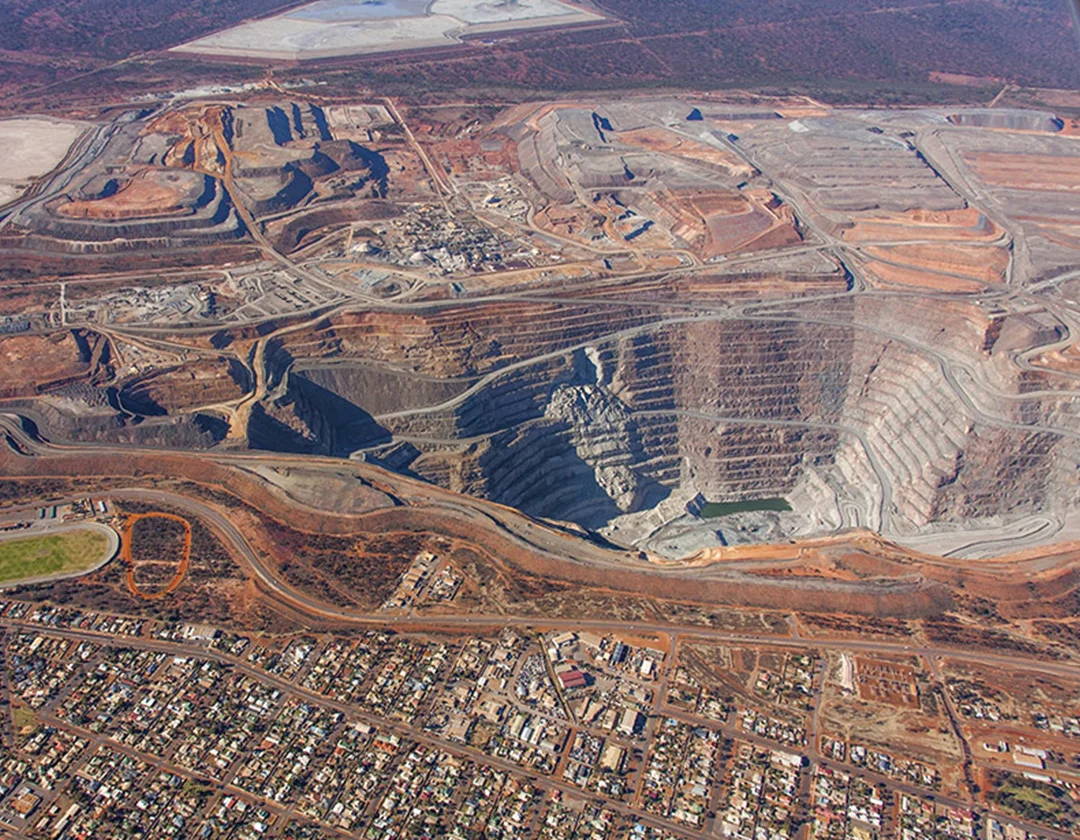
Mining slurry pipelines
Industrial liquid transportation
Pipeline rehabilitation and insertion renewal
An important point for new buyers is that ASTM F714 is not an application-specific standard for only water pipe or sewer pipe. It is fundamentally a PE pipe product specification covering dimensions, materials, performance requirements, pressure ratings and quality-control requirements.
The final project specification may require ASTM F714 together with other standards.
▎Understanding IPS, DIPS and Metric HDPE Pipe
This is one of the most important concepts for anyone purchasing ASTM F714 HDPE pipe.
ASTM F714 recognizes different outside diameter systems.
IPS – Iron Pipe Size
IPS means Iron Pipe Size.
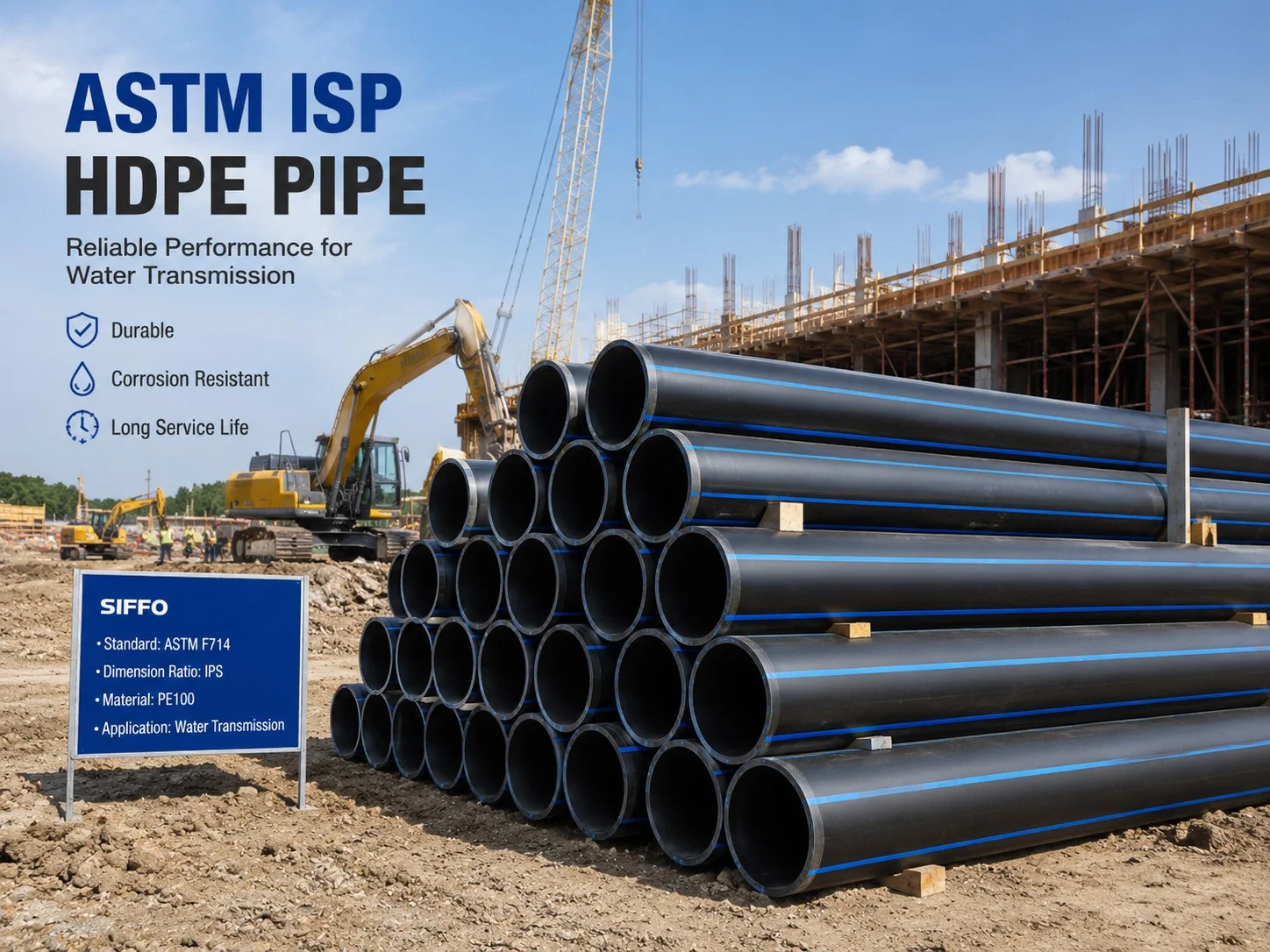
Despite the name, an IPS HDPE pipe is still polyethylene pipe. The term refers to the dimensional system used to establish its outside diameter.
IPS HDPE pipe is widely used in North American infrastructure and industrial pipeline projects.
Typical descriptions may look like:
or
24" IPS PE4710 DR17 HDPE Pipe
The important point is that the nominal size is not necessarily the actual outside diameter.
For example, a buyer should not assume that:
12-inch HDPE pipe = exactly 12.000 inches OD.
Always check the applicable dimensional table.
DIPS – Ductile Iron Pipe Size
DIPS means Ductile Iron Pipe Size.
This dimensional system is especially important when HDPE pipelines need to interface with existing ductile iron water infrastructure.
A quotation may therefore specify:
12" DIPS PE4710 DR11
rather than:
12" IPS PE4710 DR11.
These are not interchangeable descriptions.
Even when both pipes are called “12-inch HDPE pipe,” their actual outside diameters are different.
This affects:
Electrofusion fittings
Mechanical couplings
Flange adapters
Valves
Reducers
Transition fittings
Existing pipeline connections
Buyer Tip
Never send a purchase inquiry that says only:
“We need 12-inch ASTM F714 HDPE pipe.”
Instead, specify:
12" IPS or 12" DIPS + material + DR + application + operating pressure.
This can prevent one of the most expensive mistakes in HDPE pipe procurement: ordering the correct nominal diameter but the wrong outside-diameter system.
▎What Does DR Mean in ASTM F714 HDPE Pipe?
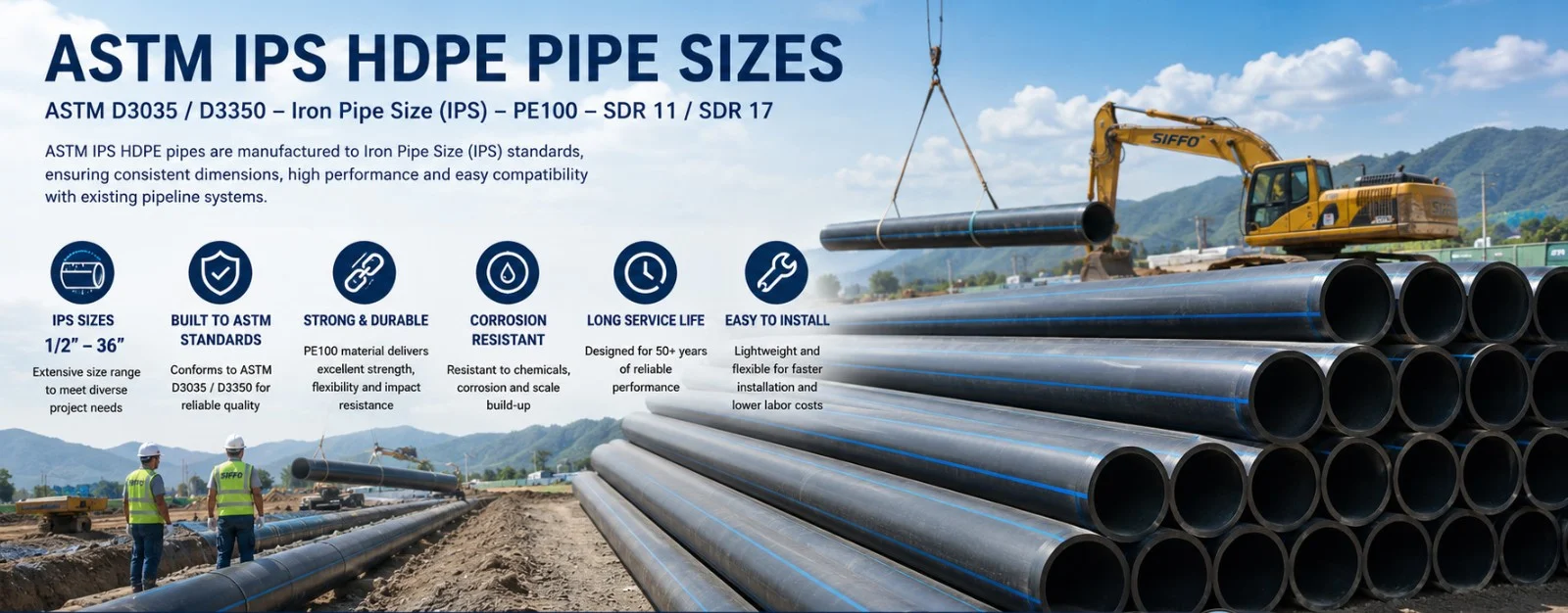
Another critical concept is DR – Dimension Ratio.
In simplified form:
DR = Pipe Outside Diameter ÷ Minimum Wall Thickness
For example:
DR7
DR9
DR11
DR13.5
DR17
DR21
DR26
DR32.5
may appear in American HDPE pipe specifications.
The basic relationship is:
Lower DR → thicker wall → generally higher pressure capability
Higher DR → thinner wall → generally lower pressure capability
For example, for pipes of the same OD and PE material:
DR11 has a thicker wall than DR17.
This does not mean DR11 is always the correct choice.
A pipeline designer should select the DR according to:
Operating pressure
Surge pressure
Operating temperature
Fluid
Installation conditions
Design safety factors
Required flow capacity
External loading
Project design criteria
Therefore, buyers should avoid selecting DR simply because another project used the same size.
▎What Is PE4710?
For modern North American pressure-pipe projects, buyers will frequently encounter PE4710.
PE4710 is not a pipe size and it is not a pressure rating.
It is a polyethylene material designation used in the North American PE piping industry.
The material classification and properties of polyethylene piping compounds are closely associated with ASTM D3350.
For purchasing purposes, think of the relationship this way:
PE4710 = material designation
ASTM F714 = pipe product specification
IPS / DIPS = dimensional system
DR = OD-to-wall-thickness relationship
PR = pressure rating
A complete procurement description could therefore look like:
ASTM F714 PE4710, 12" IPS, DR11 HDPE Pipe
This is far more meaningful than simply requesting:
“12-inch HDPE pipe.”
▎Which Applications Commonly Use ASTM F714 HDPE Pipe?
ASTM F714 has a broad application scope.
1. Municipal Potable Water Systems
Large-diameter HDPE pipe is widely used for:
Water transmission mains
Municipal distribution mains
Raw water pipelines
Treated water transmission
Pipeline replacement
Trenchless rehabilitation
For drinking-water projects, ASTM F714 alone is generally not enough.
The project may additionally require:
AWWA C906
NSF/ANSI/CAN 61
NSF/ANSI/CAN 372
Utility-specific approvals
NSF listings show PE4710 ASTM F714 pipe certified for potable-water applications under NSF/ANSI/CAN 61, demonstrating that ASTM F714 and drinking-water health certification are separate but complementary requirements.
2. Municipal Sewer and Wastewater Pipelines
ASTM F714 PE pipe may also be used for:
Force mains
Pressure sewer systems
Wastewater transmission
Effluent pipelines
Sewage pipelines
Rehabilitation of existing pipelines
HDPE is particularly attractive where corrosion resistance and leak-resistant fused joints are important.
For gravity sewer projects, however, engineers may specify different pipe standards depending on the design.
Therefore:
“Sewer pipe” does not automatically mean ASTM F714.
Always check whether the project calls for pressure-rated solid-wall PE pipe under ASTM F714 or another sewer-specific product.
3. Industrial Process Water
Industrial facilities may use ASTM F714 HDPE pipe for:
Cooling water
Process water
Utility water
Industrial wastewater
Effluent
Chemical-process pipelines
For chemical transportation, buyers must check chemical compatibility separately.
Compliance with ASTM F714 does not mean HDPE is automatically suitable for every chemical.
Fluid concentration, temperature and exposure conditions must be evaluated.
4. Mining and Slurry Pipelines
Large-diameter HDPE is commonly selected for mining applications such as:
Mine water
Slurry transportation
Tailings pipelines
Dewatering
Process water
Mineral-processing facilities
ASTM F714 can provide the dimensional and pressure-pipe basis for such pipelines.
However, highly abrasive slurry systems may require additional engineering analysis of:
Abrasion
Flow velocity
Particle size
Solids concentration
Temperature
Surge pressure
Bend radius
External loading
5. Dredging Pipelines
HDPE pipe is widely used in dredging systems because of its:
Flexibility
Corrosion resistance
Relatively low weight
Fusion-jointed construction
Ability to accommodate floating and shore-based pipeline layouts
ASTM F714 may be specified for solid-wall HDPE dredging pipe, but the complete dredging system also requires consideration of flanges, floats, wear behavior and operating conditions.
6. Pipeline Rehabilitation
ASTM F714 specifically includes PE piping intended for both new construction and insertion renewal of existing piping systems.
HDPE is frequently considered for rehabilitation because long continuous pipe sections can be installed using trenchless methods.
Applications may include:
Sliplining
Pipe insertion
Water-main rehabilitation
Sewer-main rehabilitation
Industrial pipeline renewal
The final pipe OD and DR must be selected according to the host pipe, hydraulic requirements and structural design.
▎Important Standards Related to ASTM F714
For procurement purposes, ASTM F714 should be understood as part of a larger standards system.
Standard | Main Function | Why Buyers Should Know It |
ASTM F714 | PE pipe specification based on OD and DR/PR | Core pipe product specification |
ASTM D3350 | Classification of polyethylene plastics pipe and fittings materials | Important for verifying PE material |
ASTM D3035 | OD-controlled PE pressure pipe | Important especially for smaller pipe sizes |
ASTM D2837 | Hydrostatic design basis for thermoplastic pipe materials | Related to long-term pressure design |
ASTM F2620 | Heat fusion joining of PE pipe and fittings | Important for butt fusion and installation |
ASTM D3261 | Butt heat fusion PE fittings | Relevant when buying molded/fabricated butt-fusion fittings |
ASTM F1055 | Electrofusion-type PE fittings | Relevant when electrofusion fittings are required |
AWWA C906 | PE pressure pipe and fittings for waterworks | Particularly important for municipal water projects |
NSF/ANSI/CAN 61 | Drinking-water health effects | Important for potable-water applications |
ASTM D2513 | PE gas pressure pipe, tubing and fittings | Important for gas distribution applications |
This is why experienced buyers rarely ask only:
“Does your pipe comply with ASTM F714?”
They ask:
“Which material, dimensional, application, joining and certification standards does the complete piping system comply with?”
▎How to Purchase ASTM F714 HDPE Pipe
For new buyers, the best approach is to build a complete specification before requesting quotations.
1. Confirm the Application
Start with:
Potable water?
Raw water?
Wastewater?
Sewer force main?
Industrial water?
Mining slurry?
Dredging?
Chemical fluid?
Pipeline rehabilitation?
The application determines what additional standards and certifications may be required.
2. Confirm the Material
For many modern North American pressure-pipe projects, the specification may require:
PE4710
Do not accept a quotation that says only:
“100% virgin HDPE.”
“Virgin HDPE” is not a complete engineering material specification.
Request the actual material designation and supporting technical documentation.
3. Confirm IPS or DIPS
This is one of the most important purchasing checks.
Ask:
Is the required pipe IPS or DIPS?
Do not assume they are interchangeable.
This is especially critical when the new HDPE pipeline connects to:
Existing ductile iron pipe
Valves
Flanges
Mechanical couplings
Electrofusion fittings
Pumps
Existing water mains
4. Confirm DR
Never purchase ASTM F714 pipe based only on nominal diameter.
A proper inquiry should include the required DR.
For example:
12" IPS PE4710 DR11 ASTM F714
rather than:
12" HDPE pipe ASTM F714.
5. Check Operating Pressure and Surge Pressure
The pipe should be selected according to the actual hydraulic design.
The buyer should provide the supplier or engineer with:
Normal operating pressure
Maximum operating pressure
Surge pressure
Operating temperature
Fluid
Design life
Installation conditions
Do not select DR only according to a generic pressure chart found online.
6. Check Temperature
Pressure capability is affected by operating temperature.
A pressure rating associated with standard reference conditions should not automatically be applied to a pipeline operating at substantially elevated temperatures.
Industrial buyers should therefore clearly specify:
maximum continuous operating temperature.
7. Check Potable-Water Certification
For drinking-water projects, verify:
NSF/ANSI/CAN 61 if required
NSF/ANSI/CAN 372 if applicable
Local water utility approval
Project-specific certification requirements
Do not assume “food grade,” “virgin PE” or “ASTM compliant” means NSF-certified.
8. Check Fittings
A pipeline is a system, not just a pipe.
The quotation should confirm compatibility of:
Butt fusion fittings
Electrofusion couplers
Electrofusion elbows
Electrofusion tees
Reducers
Flange adapters
Backing rings
Mechanical transitions
Valves
The fitting dimensional system must match the pipe.
An IPS pipe requires fittings compatible with that IPS OD.
9. Check Fusion Compatibility
HDPE pipelines commonly use:
Butt fusion
Electrofusion
The joining procedure should follow the applicable project specification and recognized joining practices such as ASTM F2620 where required.
Buyers should also confirm:
Pipe OD
DR
PE material compatibility
Fusion equipment range
Heater plate size
Electrofusion fitting compatibility
Installer qualification requirements
10. Ask for Quality Documentation
For an international ASTM F714 HDPE pipe order, consider requesting:
Material certificate
Raw-material batch information
Pipe dimensional inspection report
Hydrostatic test documentation
Production batch number
Certificate of Conformity
Applicable third-party certifications
NSF certificate where required
Factory quality documentation
Pipe marking photographs
Packing list and traceability records
The exact documentation should be agreed upon before production.
▎ASTM F714 vs ISO 4427 / EN 12201
International buyers may also encounter ISO 4427 and EN 12201.
Although all of these standards can apply to polyethylene pressure piping, they use different dimensional, material and design conventions.
Feature | ASTM F714 | ISO 4427 / EN 12201 |
Market | Strong North American relevance | International / European markets |
Typical material terminology | PE4710 commonly encountered | PE100 commonly encountered |
Size terminology | IPS / DIPS / Metric | Metric OD |
Wall classification | DR | SDR |
Waterworks companion standard | AWWA C906 often relevant | EN/ISO requirements |
Potable-water certification | NSF 61 may be required in North America | Depends on country/project |
A buyer should therefore avoid simply converting an ISO 4427 pipe quotation into an ASTM F714 quotation based on millimeters and inches.
The complete dimensional and engineering requirements must be checked.
▎FAQ About ASTM F714 HDPE Pipe
1. Is ASTM F714 only for water pipe?
No. ASTM F714 covers PE piping used for water, municipal and domestic sewage, industrial process liquids, effluent, slurry and other suitable applications in pressure and nonpressure systems.
2. What is ASTM F714 PE4710 pipe?
It normally refers to PE pipe manufactured to ASTM F714 using a PE4710-classified polyethylene material.
3. What is the difference between IPS and DIPS HDPE pipe?
IPS and DIPS are different outside-diameter sizing systems. Pipes with the same nominal size can therefore have different actual outside diameters.
4. Is DR11 stronger than DR17?
For the same OD and material, DR11 has a thicker wall than DR17 and generally provides higher pressure capability. Actual design pressure must still be calculated according to material, temperature and service conditions.
5. Does ASTM F714 require PE4710?
Buyers should refer to the exact edition of ASTM F714 and project specification for permitted material requirements. In modern North American pressure-pipe projects, PE4710 is commonly specified.
6. Is ASTM F714 the same as AWWA C906?
No. They are different standards. ASTM F714 is a PE pipe specification, while AWWA C906 addresses polyethylene pressure pipe and fittings for waterworks applications. Municipal water projects may reference both.
7. Is ASTM F714 used for natural gas pipe?
Polyethylene gas distribution piping is generally governed by gas-specific requirements such as ASTM D2513 and applicable regulations. Buyers should not assume ASTM F714 alone is the correct specification for gas service.
8. Can ASTM F714 HDPE pipe be used for mining slurry?
Yes, ASTM F714 PE pipe may be specified for slurry and mining pipeline applications. However, abrasion, velocity, solids concentration, pressure, surge and chemical compatibility must also be evaluated.
9. What documents should I request from an ASTM F714 HDPE pipe manufacturer?
Depending on the project, buyers may request material certificates, dimensional inspection reports, pressure-test documentation, production traceability, Certificate of Conformity, third-party certifications and potable-water certification where applicable.
▎Conclusion
ASTM F714 may appear complicated to a first-time HDPE pipe buyer, but the purchasing logic becomes much easier once the specification is divided into several questions:
What is the application?
What PE material is required?
Is the pipe IPS, DIPS or metric?
What diameter and DR are required?
What operating and surge pressures must the pipeline handle?
Does the project require AWWA C906, NSF 61 or other certifications?
What fittings and joining methods will be used?
The most important lesson is that “ASTM F714 HDPE pipe” is not a complete purchase specification by itself.
A properly defined order should combine the pipe standard with the required material, OD sizing system, nominal size, DR, pressure conditions, application, fittings and certifications.
For engineering projects, this approach helps buyers compare quotations on an equivalent basis and significantly reduces the risk of ordering a pipe that meets a general ASTM specification but does not match the actual pipeline design.