



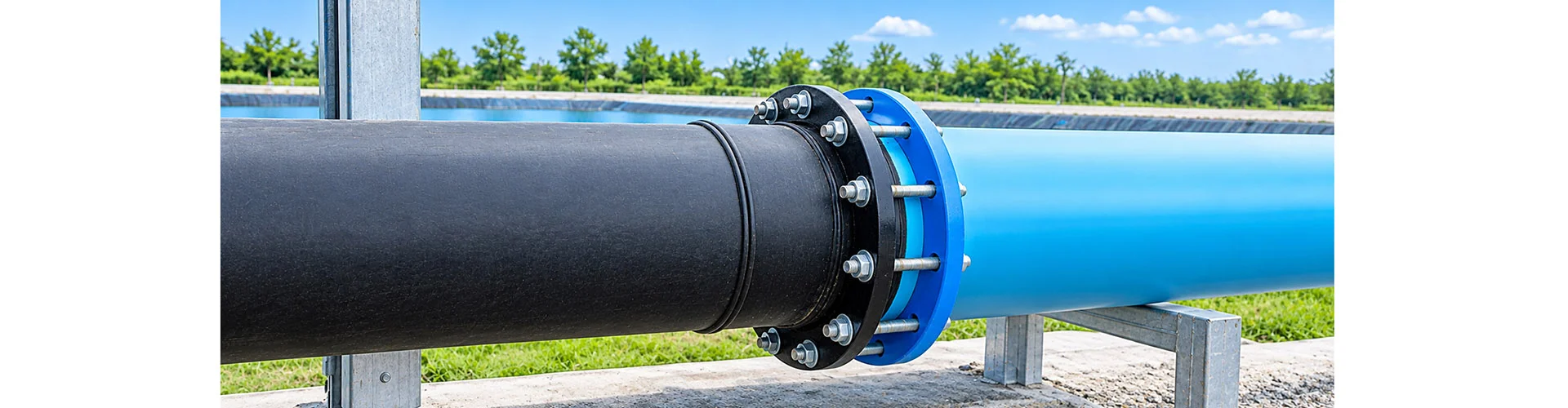
Connections between HDPE pipes themselves are highly reliable—butt fusion or electrofusion can create joints with a strength nearly equal to that of the pipe body itself. However, in engineering practice, it is rarely possible for an entire pipeline to consist solely of HDPE. For example:
- New HDPE water supply pipelines may need to be connected to existing PVC water supply networks.
- HDPE pipelines may need to be connected to municipal ductile iron mains.
- Industrial pipelines may require connections to steel valves, pump stations, or equipment interfaces.
- HDPE drainage pipelines may need to be integrated into existing concrete drainage systems.
- HDPE pipelines may need to be connected to stainless steel flanges or metal fittings.
Due to differences in physical properties, dimensional standards, connection configurations, and coefficients of thermal expansion, such materials cannot simply be joined together directly.
Selecting the appropriate connection method and ensuring installation is carried out in accordance with technical standards are essential for the safe operation of the entire piping system, as well as for preventing joint leakage and structural damage.
Why can't they be connected directly?
HDPE possesses physical properties that differ significantly from those of metals, PVC, or concrete. While metals and PVC typically rely on threads, welding, or adhesives to form rigid connections, HDPE is a thermoplastic material that fuses through thermal diffusion at the molecular level. Furthermore, HDPE has low surface energy, making it difficult for adhesives or standard threaded joints to maintain a reliable seal under long-term pressure and temperature fluctuations. More importantly, the coefficient of linear thermal expansion for HDPE is far greater than that of metals or rigid plastics; significant temperature variations lead to substantial expansion, contraction, and displacement at the connection point. Attempting a rigid connection under these conditions would likely result in the pipe cracking due to stress, or cause damage to adjacent valves, metering equipment, or brittle fittings.
Therefore, the fundamental principle for joining dissimilar materials is straightforward: utilize specialized transition fittings—designating the "butt-fusion/electrofusion" end for the HDPE, and the "threaded/flanged/socket" end for the connecting material.
Connecting HDPE to Metal Pipes and Valves
Flange Connection
Flange connection is the most common and widely used method for joining HDPE pipes to metal pipes. It is particularly well-suited for connecting HDPE pipes to steel pipes, ductile iron pipes, stainless steel pipes, valves, and equipment at pumping stations.
Installation Procedure:
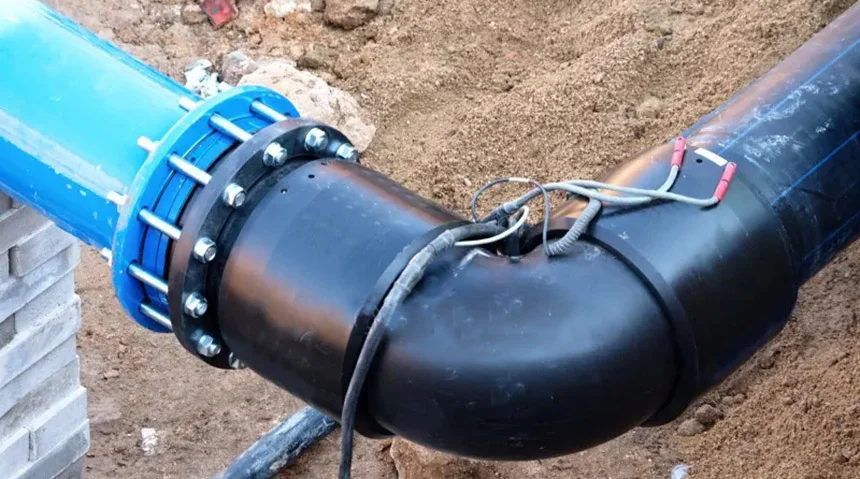
Installation of Flange Adapters and Metal Backing Rings: First, select an HDPE flange adapter and a steel backing ring (often referred to as a "loose" or "lap-joint" flange) that match the outer diameter, SDR rating, and design pressure of the HDPE pipeline. During installation, slide the steel backing ring onto the end of the HDPE pipe, then use butt-fusion equipment to weld the HDPE flange adapter to the main HDPE pipeline. Once the welding is complete and the joint has cooled sufficiently, position the steel backing ring against the flange face of the adapter, ensuring proper alignment and a secure fit.
Installation of Gaskets: Place a gasket between the mating faces of the two flanges. The gasket material must be selected based on the conveyed medium, operating pressure, and service temperature, and its dimensions must correspond to the flange specifications. During installation, center the gasket between the flange faces, ensuring it lies flat without shifting or obstructing the bolt holes. This ensures uniform pressure distribution across the sealing surface and prevents leakage caused by a misaligned gasket.
Bolt Tightening: Bolt tightening is a critical phase in HDPE flanged connections where issues frequently arise. Bolts should not be tightened to their final torque in a single pass; instead, a cross-pattern, multi-stage, incremental tightening method must be employed. Begin by hand-tightening all bolts to ensure the flange faces remain parallel and properly aligned. Then, following the specified tightening sequence, apply force in a diagonal, cross-pattern approach, increasing the torque in multiple stages until the target torque—as defined by the manufacturer or project specifications—is reached. If necessary, an initial pre-tightening stage (e.g., at 20% of the target torque) can be applied before gradually increasing the torque. This ensures uniform circumferential pressure on the flange and prevents localized stress concentrations.
When connecting an HDPE flange to a flange made of a rigid or relatively brittle material—such as ductile iron or PVC—extra care must be taken to strictly control the tightening torque. Excessive preload, a lack of parallelism between flange mating surfaces, or uneven bolt loading can lead to flange cracking or damage to the sealing structure. Therefore, the torque specifications provided by the component manufacturer must be strictly followed; applying a uniform, standardized tightening torque is not appropriate.
Furthermore, HDPE exhibits viscoelastic properties, meaning it undergoes a degree of creep and stress relaxation under sustained compressive loads. This causes the bolt preload in a flange connection to gradually decrease over time. For flange connections that require retightening, an inspection should be conducted after a specified period following the initial tightening—taking into account the gasket type, bolt material, flange design, and the manufacturer’s technical requirements. If necessary, the bolts should be retightened to compensate for the loss of preload and ensure the long-term sealing integrity of the connection.
Steel-to-Plastic Transition Fitting
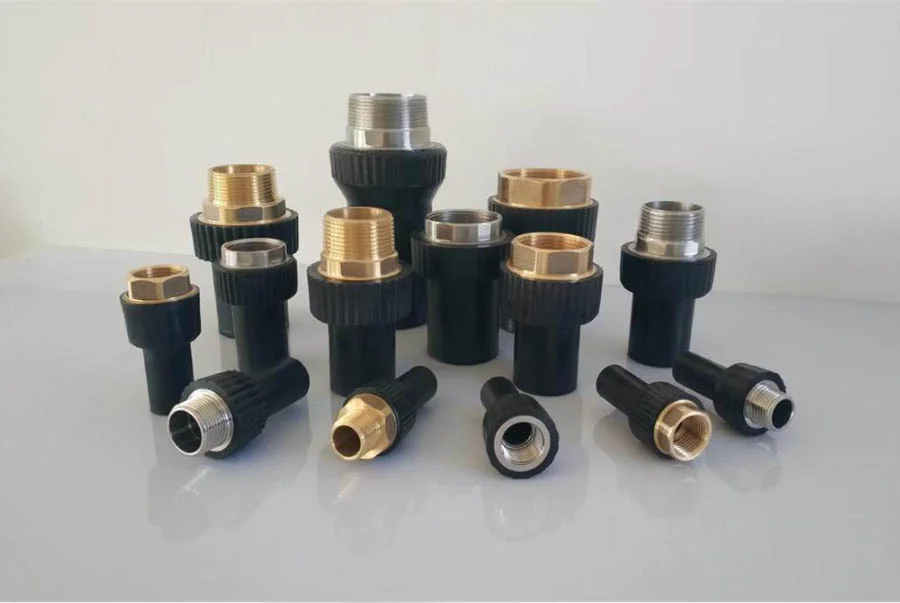
A steel-to-plastic transition fitting offers another highly efficient solution, particularly for small-diameter applications or scenarios requiring a threaded transition. Its design features one end for HDPE and the other for steel: the plastic end connects to an HDPE pipe via butt fusion or electrofusion, while the steel end interfaces with a metal piping system through threading or welding. The pressure rating of a steel-to-plastic transition fitting must not be lower than the nominal pressure of the pipes to which it is connected; therefore, when selecting such a fitting, one must verify not only that the diameter matches but also that the pressure rating is appropriate.
Designed to bridge different materials and connection types, steel-to-plastic transition fittings enable the integration of HDPE pipelines with systems made of PVC, steel, copper, or other materials.
Prev: None