

HDPE Pipe for Tailings Transport: How to Select the Right Mining Pipeline
Tailings pipelines carry more than wastewater. They transport mixtures of water, fine mineral particles and, in some operations, residual process chemicals. A suitable pipeline must handle internal pressure, particle abrasion, changing operating conditions and the demands of a mine site.
Selecting HDPE pipe for tailings transport therefore starts with the slurry and the route—not simply the pipe diameter or purchase price. Engineers need to match material grade, wall thickness, hydraulic capacity, fittings and installation methods to the actual duty.
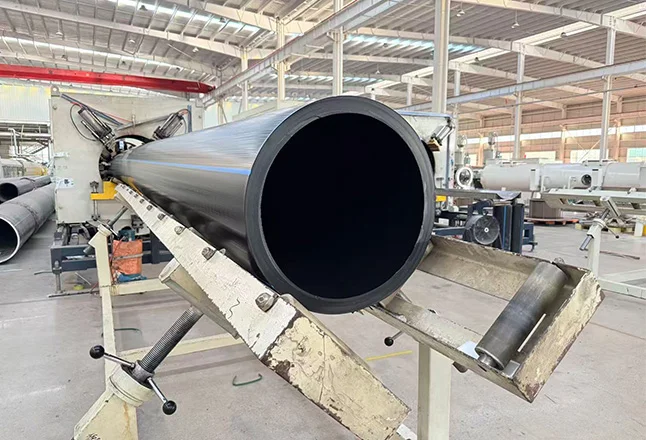
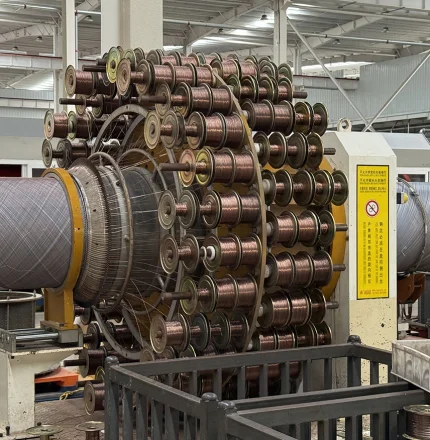
Shandong SIFFO Plastic Technology Co., Ltd. supplies HDPE and HDPE-RC piping options for mining projects. With large-scale manufacturing capacity and coordinated pipe-and-fitting supply, SIFFO supports international buyers seeking a practical piping package for tailings, process water and mine infrastructure.
What Conditions Must a Tailings Pipeline Meet?
Abrasion resistance suited to the actual solids
Tailings vary considerably between mines. Particle hardness, shape, size distribution and solids concentration all influence wear. Fine particles in one operation may behave differently from coarse, angular particles in another.
Assess abrasion under representative slurry conditions. Pay particular attention to bends, reducers, pump discharge areas and other locations where particles change direction or strike the wall. A material designation alone cannot establish the wear life of a tailings pipeline.
Where wear is significant, include an engineered wear allowance and inspection plan. Establish the minimum remaining wall thickness required for safe service rather than assuming that the original pressure rating remains valid after material has worn away.
Adequate pressure capacity throughout the route
A tailings line must accommodate normal operating pressure, elevation effects and relevant transient conditions. Pump starts, pump trips, valve movement and abnormal operating events can change the pressure substantially.
Slurry density matters: the static pressure associated with a given elevation difference increases with fluid density. A calculation based only on water may underestimate the pressure in a denser tailings mixture.
Review sustained pressure, recurring surges, occasional surges and fatigue using the governing design rules. Also assess possible vacuum conditions and external loading where the line could drain or experience negative pressure.
Chemical compatibility
HDPE resists rust and offers useful resistance to many chemicals found in mining service. Nevertheless, compatibility must be checked against the complete mixture, including residual reagents, concentration and temperature.
A low or high pH alone does not establish compatibility. Oxidizing chemicals, solvents and changing process chemistry require specific evaluation. Gaskets, valves and transition fittings must also suit the fluid.
Reliable joints and controlled installation
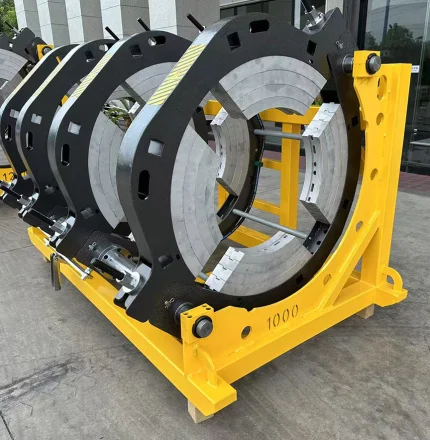
Properly executed butt fusion or electrofusion can create a continuous pipeline with fewer potential leakage points. Reliable joints depend on compatible components, qualified procedures, clean surfaces, suitable equipment and trained operators.
At pumps, valves and equipment interfaces, flanged connections can provide maintenance access. Their pressure capacity, backing rings, gaskets, bolts and restraint arrangements need to be specified as part of the system.
Resistance to site and environmental loads
Mine pipelines may cross rocky ground, uneven terrain, roads and areas subject to settlement. Aboveground installations also experience thermal expansion, solar heating and support loads.
Check bending limits, support spacing, anchorage, burial conditions and traffic loads. In cold locations, include a plan for freezing and shutdowns. The pipe must remain suitable for its operating environment as well as for the fluid inside it.
Why Consider HDPE Pipe for Tailings Transport?
A useful combination of abrasion and corrosion resistance
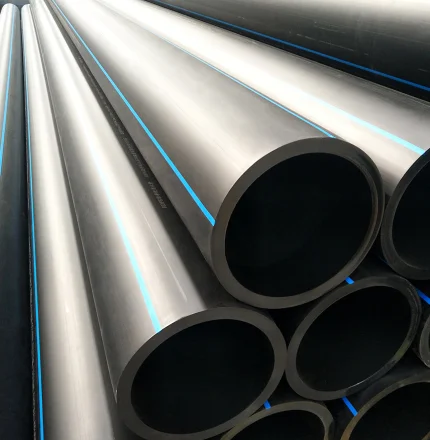
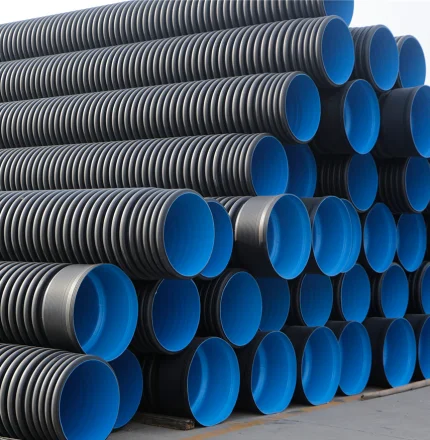
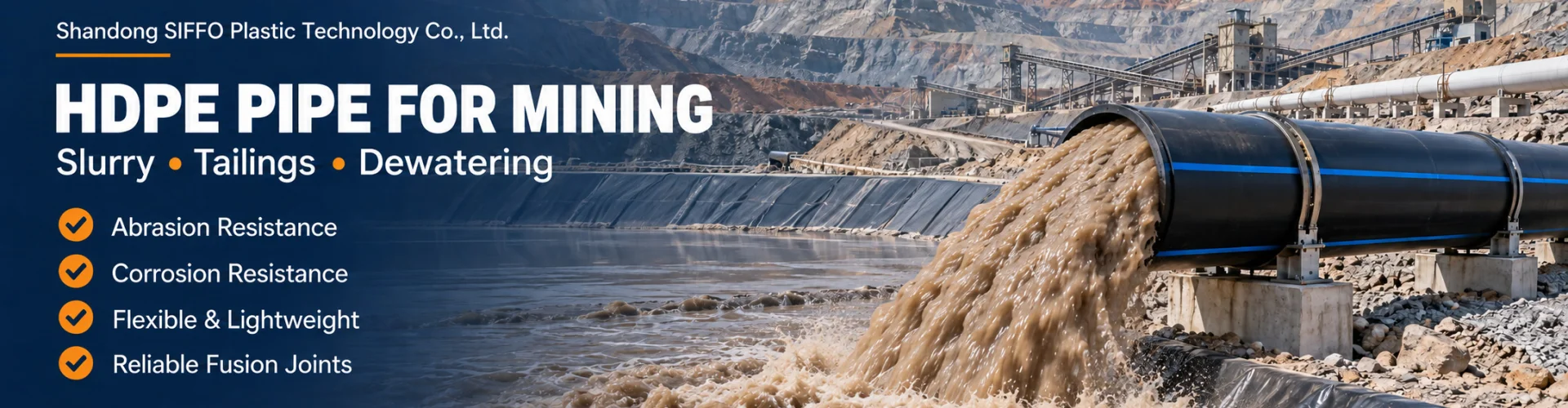
HDPE is an established option for slurry and tailings conveyance. The Plastics Pipe Institute identifies tailings transportation and process slurry among polyethylene’s mining applications, highlighting abrasion resistance, chemical resistance and installation advantages.
This combination can make HDPE attractive where an unprotected metallic line would face both particle wear and corrosion. The correct comparison, however, is between complete systems under the same slurry conditions. HDPE should not be assumed to outperform every lined steel or specialist wear-resistant pipe.
Lower handling weight and flexible routing
Compared with many metallic alternatives, HDPE can simplify handling and reduce the lifting requirements associated with individual pipe lengths. This is valuable on remote sites with limited access.
Its flexibility can also help a pipeline follow gradual changes in terrain. Route design must still respect minimum bending radii, allowable pulling loads and the requirements of valves and equipment connections.
Fusion joints for long pipeline runs
Fusion jointing can reduce dependence on repeated mechanical connections along permanent routes. This supports containment and can reduce maintenance associated with joint leakage.
For lines that require regular dismantling or relocation, a designed flanged arrangement may be more practical. The jointing strategy should follow the mine's operating plan.
Potential savings over the operating life
A competitive pipe price is only one part of project cost. Freight, installation, supporting structures, pumping energy, inspections, replacement work and production interruptions all affect the result.
HDPE can offer lifecycle advantages when its pressure capacity, wear performance and installation requirements fit the application. Evaluate those advantages using project-specific assumptions rather than a universal service-life or cost-saving claim.
How to Size and Specify an HDPE Tailings Pipeline
Start with a slurry data sheet
Provide the supplier and pipeline designer with:
Required flow rate and operating range.
Slurry density and solids concentration, stating whether concentration is by mass or volume.
Particle size distribution, maximum particle size, hardness and abrasivity information.
Fluid chemistry and minimum, normal and maximum temperatures.
Pipeline length, elevation profile and installation arrangement.
Pump operating data, expected pressure conditions and shutdown frequency.
These inputs help establish the hydraulic duty and the material's suitability.
Select diameter from slurry hydraulics
A larger diameter reduces velocity at the same flow rate, but an excessively low velocity may allow settling. Excessive velocity can increase wear and energy demand.
There is no universal best velocity for every tailings slurry. Use a suitable slurry transport model and, where needed, representative test data to determine a practical operating range. For thickened or paste tailings, obtain rheological data and assess restart conditions.
Use the actual internal diameter. Changing SDR changes wall thickness and therefore the available flow area even when the outside diameter stays the same.
Select wall thickness for the complete duty
For a given material and outside diameter, a lower SDR generally means a thicker wall and higher nominal pressure capacity. It also reduces internal diameter and increases pipe weight.
Select the wall for the governing pressure and structural requirements, temperature effects and wear allowance. Assess the remaining wall at the planned retirement limit. PN16 or SDR11, for example, should not be treated as automatically suitable for every mine.
Temperature also matters. Elevated operating or pipe-wall temperatures can reduce allowable pressure; apply the appropriate material and design-standard factors.
Plan maintenance into the design
Identify locations likely to experience concentrated wear and make them accessible. Consider replaceable spools where appropriate, safe isolation and flushing arrangements, and a wall-thickness inspection method suitable for the pipe.
Define how the line will be emptied, flushed or restarted after a shutdown. Good operation and maintenance are part of pipe selection, particularly when solids can settle.
SIFFO HDPE and HDPE-RC Pipe Export Advantages
Manufacturing capacity for substantial project orders
Shandong SIFFO Plastic Technology Co., Ltd. operates two production bases in Linyi, Shandong, and Nanjing, Jiangsu, with a combined site area exceeding 150,000 m².
SIFFO’s company-wide annual production capacity exceeds 450,000 tonnes. Its HDPE manufacturing capacity exceeds 200,000 tonnes per year, supported by 20 HDPE extrusion lines.
For international mining buyers, this production scale supports procurement planning for substantial pipeline quantities and phased project requirements. Delivery schedules should be confirmed against the specified grade, dimensions and order volume.
HDPE and HDPE-RC options for different routes
SIFFO's HDPE and HDPE-RC product offering allows buyers to discuss material selection against both the slurry duty and the installation environment. The company also publicly lists a PE100-RC mining pipe product.[6]
For each export order, agree on the resin designation, applicable standards, OD, SDR or DR, length and acceptance documents before production. Where PE4710 is specified, confirm the relevant material qualification and dimensional requirements for the offered product.
Coordinated pipe, fittings and connection requirements
A mining pipeline purchase often includes reducers, bends, tees, flange adapters and equipment transitions alongside straight pipe.
SIFFO can coordinate the proposed supply package around the project’s dimensions and jointing requirements. Checking compatibility at the quotation stage helps buyers avoid mismatched components and unclear pressure ratings.
Customization and export planning
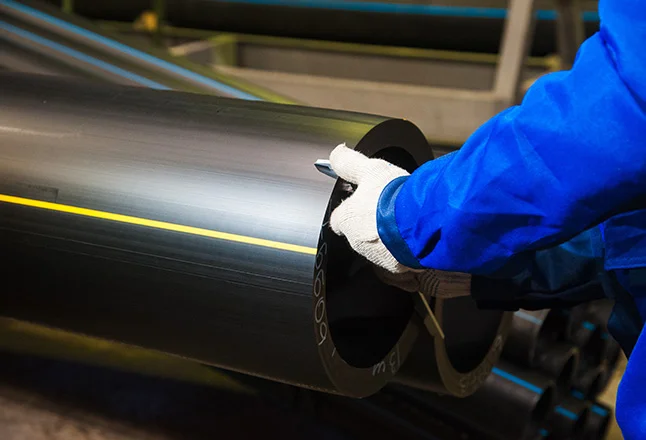
SIFFO can coordinate production lengths, pipe markings, packaging and quality documentation according to the agreed contract. Standard 5.8-metre lengths or alternative lengths can be discussed against transport and site requirements.
For overseas buyers, this enables pipe supply to be planned around container loading, unloading facilities, route access and installation sequencing. Coil availability depends on diameter, wall thickness and the offered product.
Documentation that supports project acceptance
Buyers should agree on the required inspection package, which may include resin identification, batch traceability, dimensional records, hydrostatic test results and third-party inspection.
For RC orders, specify the required RC qualification evidence separately. Product certifications must be checked against their actual scope: a drinking-water approval does not demonstrate abrasion performance or suitability for a particular tailings mixture.